
.svg)
.svg)


Tibial hemimelia is an extremely rare congenital condition that affects the lower limb. It changes how a child stands, walks, and grows. Families in New Mexico often encounter this diagnosis early, sometimes during a prenatal ultrasound, and must make difficult long-term decisions that affect mobility, independence, and quality of life.
What Is Tibial Hemimelia?
Tibial hemimelia is a congenital longitudinal deficiency marked by partial or total absence of the tibia. The tibia is the main weight-bearing bone of the lower leg and forms part of both the knee and ankle joints. When this bone is shortened, underdeveloped, or completely missing, the lower limb cannot develop normal alignment or motion.
This limb deficiency may involve:
- Complete absence of the tibia
- Shortened or hypoplastic tibia
- Abnormal development of the proximal tibia or distal tibia
- Knee instability caused by missing collateral ligaments
- Ankle deformities and foot deformity involving medial rays
The extent of tibial involvement determines how the limb functions and which prosthetic strategies provide the best long-term support.
How Rare Is Tibial Hemimelia?
Tibial hemimelia is considered extremely rare. Available population data notes that:
- Approximately 1 in 1,000,000 live births are affected
- Fewer than 300 cases worldwide have been documented
This rarity means that many families in New Mexico never encounter another affected household. As a result, specialized prosthetic planning and long-term support are especially valuable.
Common Symptoms and Causes of Tibial Hemimelia
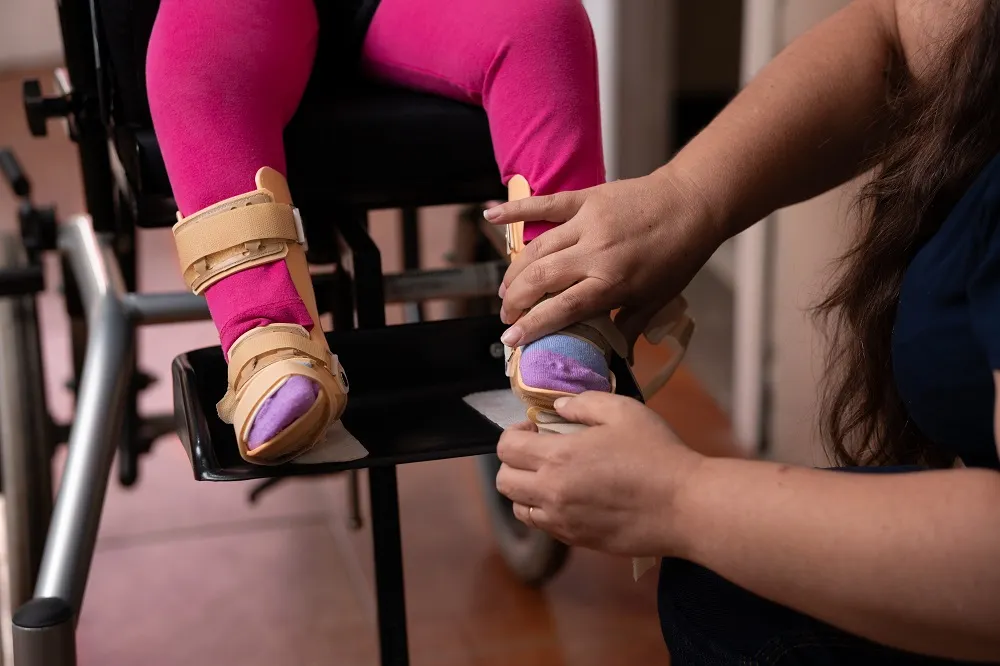
Tibial hemimelia shows up differently in each child, but several physical patterns appear consistently during physical examination.
Typical Physical Features
Tibial hemimelia presents a range of structural differences in the lower limb. These features affect bone development and joint function, influencing early movement patterns and long-term limb use:
- Absence of the tibia or severe tibial deficiency
- Knee flexion contracture with limited normal motion
- Knee instability due to missing joint support
- Ankle joint malformation or ankle deformities
- Leg length discrepancy that increases as the child grows
- Foot deformity with supination deformity
These features shape joint stability, alignment, and weight-bearing, which directly affect the design of the prosthetic and long-term mobility planning.
Potential Causes and Genetic Factors
The exact cause of tibial hemimelia isn’t always clear, but several patterns have been documented. In some families, inheritance patterns or syndromic links are observed, while in other cases appear without a family history:
- Congenital condition present at birth
- Genetic factors, including autosomal dominant inheritance in rare families
- Multiple siblings affected in documented cases
- Association with congenital femoral deficiency or Werner's syndrome
Physical signs vary widely, even among children with similar diagnoses. Early observation is key in identifying stability, alignment, and weight-bearing limits.
A Simple Explanation of the Types of Tibial Hemimelia

Several classification systems exist, but families often benefit from a function-focused explanation. The Paley classification groups tibial hemimelia by how much of the tibia is present and the functionality of the knee and ankle joints. These differences directly affect stability and prosthetic planning:
- Type 1 – hypoplastic tibia: The tibia is present but underdeveloped. The knee and ankle joints exist, but alignment problems are common.
- Type 2 – dysplastic tibia: Growth plates are present but abnormal, leading to ankle joint deformity and joint orientation issues.
- Type 3 – distal tibial deficiency: The upper tibia and knee joint are present, but the distal tibia that supports the ankle is missing.
- Type 4 – distal tibial aplasia: The knee joint exists, but the lower tibia is absent, limiting stability below the knee.
- Type 5 – complete tibial aplasia: The tibia is absent altogether. Knee stability varies, and prosthetic treatment is central to mobility.
Paley modifiers may also describe additional limb differences that influence treatment planning.

Risks of Leaving Tibial Hemimelia Untreated
Without structured prosthetics management, tibial hemimelia can lead to progressive functional limitations.
Potential risks include:
- Worsening knee instability
- Increasing flexion contracture
- Inability to develop a functional limb
- Pain during weight bearing
- Reduced participation in school, sports, and daily activities
As growth continues, untreated alignment issues tend to place increasing stress on joints above and below the affected limb. Small deviations may not seem significant, but they can compound over years, limiting endurance and confidence.
Treatment Options with Prosthetics as the Foundation
Prosthetics replace the missing structure and provide the stability needed for daily movement in tibial hemimelia. The ideal device choice depends on how the knee functions and overall limb anatomy.
- Below-knee prosthetics Used when the knee joint is stable. These devices support natural knee motion and balanced walking in cases of partial tibial absence or distal deficiency.:
- Knee disarticulation prosthetics Common in complete tibial absence. They offer strong weight-bearing, rotational control, and predictable gait development.:
- Partial foot prosthetics Used in milder cases to improve foot position, balance, and symmetry.:
Children require pediatric prosthetic updates to match growth, alignment changes, and child activity level. At PrimeCare, we work closely with your surgical team to time the prosthetic fitting perfectly with your child's recovery. Whether your child has undergone the Brown procedure or has an external fixator for limb lengthening, they’ll get a customized device fit to their unique anatomy.

Surgical Options and How Prosthetics Fit into the Plan
Surgical intervention may be considered depending on the type of tibial hemimelia.
Examples include:
- Limb amputation followed by prosthetic fitting
- Fibular centralization procedures
- Brown procedure for selected lower limb anomalies
- Limb reconstruction or deformity correction
Even when surgery is performed, prosthetic treatment remains essential for daily mobility.
When Amputation Is Considered for Tibial Hemimelia
In some forms of tibial hemimelia, the lower leg cannot support stable standing or walking due to severe bone absence and joint instability. In these cases, amputation may be recommended as part of a long-term mobility plan rather than as a last resort.
Amputation is most often considered when there is:
- Complete absence of the tibia
- Severe knee instability with no functional joint support
- Progressive flexion contracture that limits positioning
- A foot deformity that prevents weight bearing
- Limited potential for creating a functional limb through reconstruction
Common surgical approaches include knee disarticulation, Boyd-type procedures, or other limb amputation techniques selected to preserve length and soft tissue coverage. These procedures aim to create a stable residual limb that can support consistent prosthetic use.
Physical Therapy and Long-Term Outlook

Physical therapy supports strength and coordination after prosthetic fitting.
Benefits include:
- Improved control of knee and ankle movement
- Support for active quadriceps function
- Better confidence during walking and running
- Safer participation in daily activities
With consistent prosthetic care, many individuals with tibial hemimelia can maintain an active life into adulthood.
Prosthetic Care for Families Across New Mexico
Families throughout New Mexico benefit from prosthetic providers familiar with congenital limb deficiency and growth-related changes. Our hands-on care focuses on function, comfort, and long-term adaptability, not short-term fixes.